
ENGINEERING APPLICATION CASE · PACKAGING & LOGISTICS
Carton Print-and-Apply Labeling with Barcode Verification
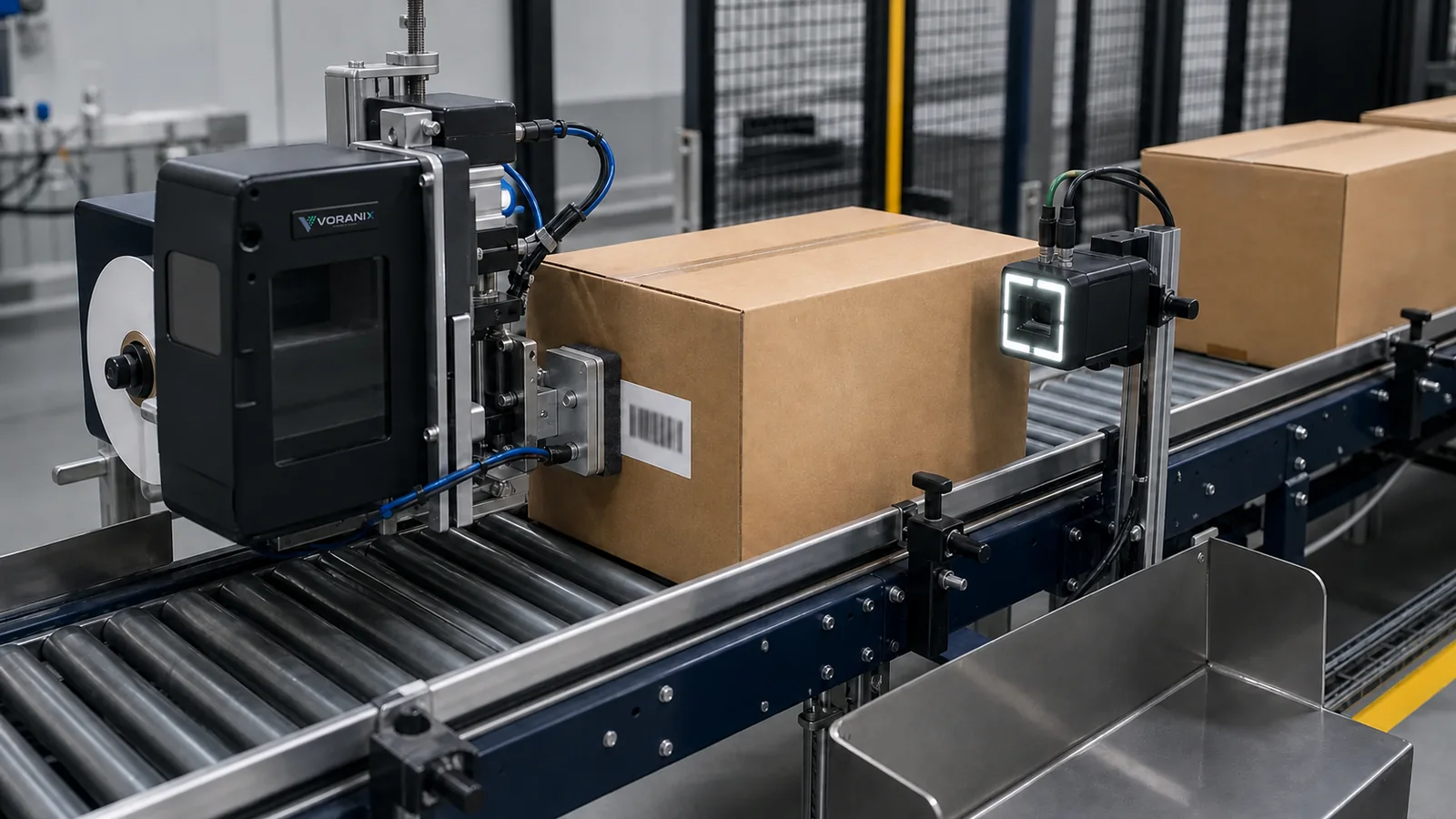
Shipping cartons require the correct label to be printed, physically applied and associated with the correct product or order. This concept links a printer-applicator, carton tracking and downstream barcode verification.
PRODUCTION CHALLENGE
What the process must control
Printing the right data is only one step. The label must release from the liner, contact the carton in the correct position and stay associated with the correct carton through inspection and any reject point. Carton height, gaps, dust, damaged surfaces and stop-start flow can all affect the result.
PRODUCT, PACKAGING & SUBSTRATE
Inputs required before equipment selection
- Provide carton dimensions, height range, surface condition, conveyor speed and minimum gap.
- Define label size, material, adhesive, apply position, barcode type and variable fields.
- Identify the data source, order-to-carton association and response to communication loss.
- Specify verification, reprint, reject, manual recovery and event-retention rules.
ACCEPTANCE CONDITIONS
Define success before trials
- Correct label content is associated with the intended carton
- Label is present, within the agreed position and acceptably adhered
- Barcode passes the defined readability or grading method
- Unverified cartons are stopped, rejected or contained without losing identity
A / B / C SOLUTION PATH
Choose the required control level
The recommended level is provisional. A VORANIX engineer must review samples, code data, line conditions, inspection criteria and system boundaries before quotation.
A. Print-and-apply labeling
Industrial label printer, applicator, product sensor, controls and approved label templates.
Discuss this option → Recommended provisional levelB. Apply and verify
Add carton tracking, barcode reader or vision, result logic and controlled reject or stop response.
Discuss this option →C. Logistics-data integration
Add order data, label commissioning, event records and scoped WMS, ERP or warehouse-control interfaces.
Discuss this option →PROVISIONAL CONFIGURATION
Recommended engineering concept
For the stated risk profile, begin with a mark-or-print and verify concept, then add traceability functions only where the data owner and recovery rules are defined.
- Print-and-apply method selected for carton face, line speed, gap and height variation
- Product sensor and tracking logic maintaining carton identity through verification
- Reader or camera selected for barcode size, distance, orientation and grading task
- Label and ribbon or print technology tested on the real corrugated surface
- Defined reject, reprint and manual-recovery workflow with operator permissions
INTEGRATION BOUNDARY
Responsibilities to agree at project start
VORANIX scope
- Printer-applicator, sensors, tracking controls and verification hardware
- Interface specification, label-format implementation and fault logic
- Integration support and documented challenge testing
Customer / line-owner scope
- Approved label stock, content, barcode specification and source data
- Conveyor condition, carton flow, reject space and guarding approval
- Order association, shipping rules, manual recovery and final release
VALIDATION PLAN
From sample to production acceptance
Run the full carton size, surface and gap range with production label stock.
Challenge missing label, skew, wrinkle, low print quality and unreadable barcode.
Test communication loss, duplicate data, reprint and manual-recovery scenarios.
Confirm carton tracking through stops, accumulation, inspection and rejection.
DESIGN TARGETS — NOT CLAIMED RESULTS
What the validated system should be designed to achieve
- Correct label data on the intended carton
- Repeatable label placement and adhesion
- Objective barcode and presence verification
- Contained recovery from print, apply or data faults
RELATED EQUIPMENT
Build the application around the process
FAQ
Engineering questions
Is barcode reading the same as barcode grading?
No. A reader can confirm decodability, while formal grading uses a defined method and controlled conditions. The required task must be specified.
How is the correct label kept with the correct carton?
Product sensing, controlled gaps, tracking logic and an agreed response to stops or accumulation are required. The design depends on the conveyor layout.
What happens after a failed verification?
The project must define stop, reject or containment behaviour plus reprint and manual-recovery permissions before production.
ENGINEERING REVIEW
Turn this application concept into a line-specific proposal
Send product samples, substrate details, code content, line speed, environment, inspection criteria and data interfaces. VORANIX will prepare two or three provisional solution paths.