A. Standalone TIJ Coding
For local high-resolution coding with controlled product movement.
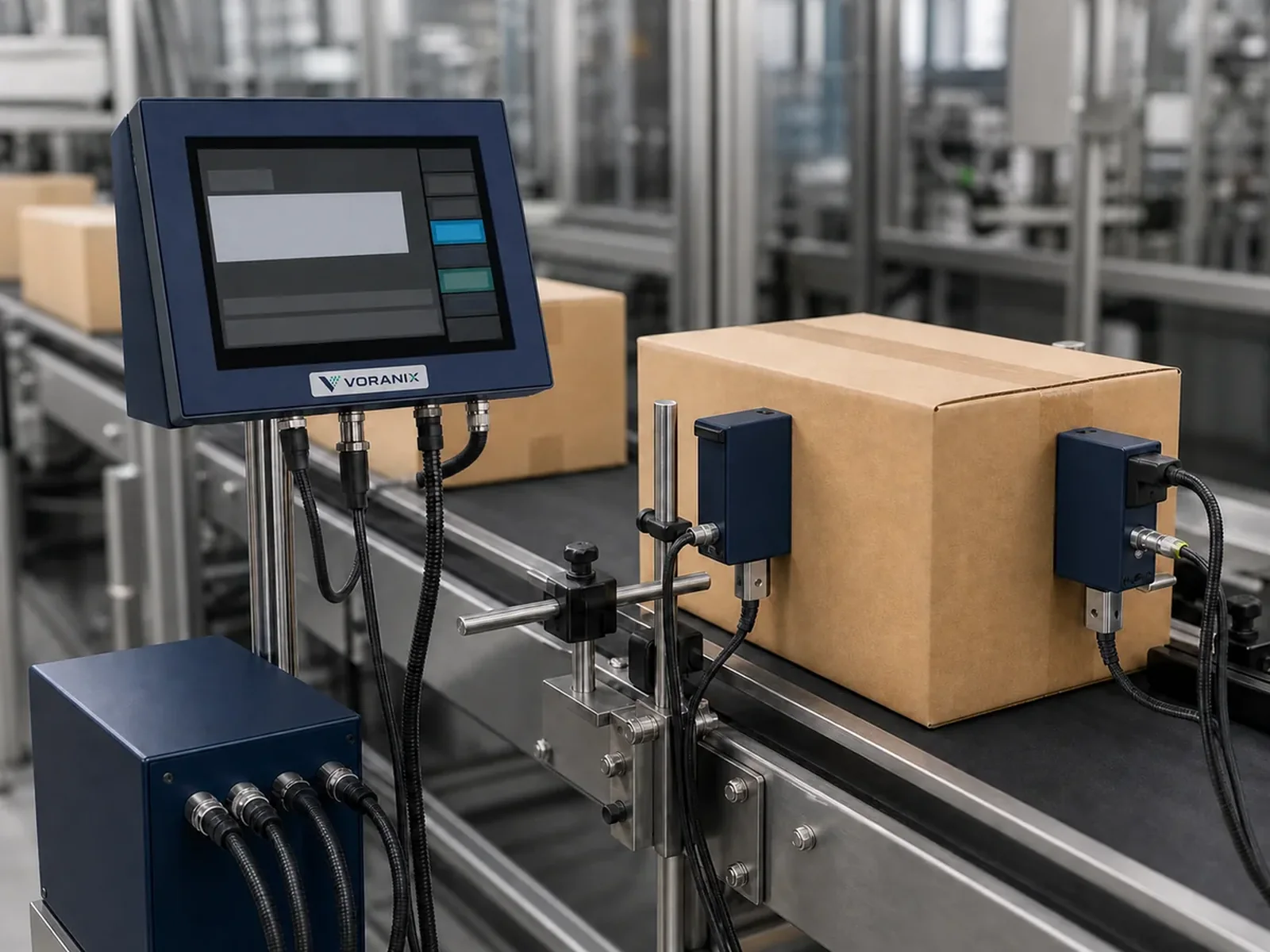
- TIJ controller, cartridge and printhead
- Sensor and mounting hardware
- Local job and message controls

High-resolution industrial coding
Configure a VORANIX TIJ system around print height, resolution, throw distance, ink compatibility, line control and the required code-verification level.
Application fit
TIJ is considered when the application needs compact, high-resolution printing and the product can pass the printhead with a controlled distance. Substrate porosity, ink chemistry, print height, resolution, line speed and head mounting determine the practical result.
Three scalable system levels
These are provisional architectures. Final components and boundaries depend on engineering discovery and verified technical data.
For local high-resolution coding with controlled product movement.
For checking printed barcode, QR or DataMatrix content.
For job-controlled or serialized printing with records.
Technical parameters
| Field | Current status | Required source |
|---|---|---|
| Model | Not supplied | Verified datasheet, model label or engineering record required |
| Printhead and Cartridge Type | Not supplied | Verified datasheet, model label or engineering record required |
| Maximum Print Height | Not supplied | Verified datasheet, model label or engineering record required |
| Resolution | Not supplied | Verified datasheet, model label or engineering record required |
| Maximum Speed and Test Conditions | Not supplied | Verified datasheet, model label or engineering record required |
| Throw Distance | Not supplied | Verified datasheet, model label or engineering record required |
| Ink Compatibility | Not supplied | Verified datasheet, model label or engineering record required |
| Controller | Not supplied | Verified datasheet, model label or engineering record required |
| Display | Not supplied | Verified datasheet, model label or engineering record required |
| Communication | Not supplied | Verified datasheet, model label or engineering record required |
| IP Rating | Not supplied | Verified datasheet, model label or engineering record required |
| Power | Not supplied | Verified datasheet, model label or engineering record required |
| Dimensions and Weight | Not supplied | Verified datasheet, model label or engineering record required |
| Applicable Materials | Not supplied | Verified datasheet, model label or engineering record required |
| Optional Functions | Not supplied | Verified datasheet, model label or engineering record required |
Material screening
Production tasks
Available visual evidence
Images are presented as application-screening evidence only. They do not establish production speed, durability, verification grade or compliance.
Selection guide
Provide total print height, message length, resolution and all code types.
State porosity, coating, color, contamination and required dry time or rub resistance.
Measure speed, spacing, acceleration, vibration and printhead gap variation.
Clarify whether the system checks presence, reads data or grades code quality.
Engineering integration
The final TIJ design must confirm cartridge and ink, print height, resolution, speed conditions, throw distance, product guidance, sensor and encoder needs, controller interfaces, inspection criteria, reject timing and operator maintenance.
No verified customer, site, model, before/after result or publication permission was found. Add a case study only after those records are supplied.
Review case-study requirementsFrequently asked questions
It may be, with a compatible ink and controlled drying conditions. The actual surface must be tested.
Potentially, but module size, resolution, speed, ink spread and verification requirements must be tested together.
The allowed throw distance depends on the verified printhead and cartridge. No numeric value should be published until the datasheet is supplied.
Consider CIJ when product presentation, surface variation or continuous high-speed non-contact coding makes a compact TIJ installation less suitable. Test both when uncertain.
Request a provisional system concept
VORANIX can compare standalone, print-and-verify and traceability options after the key application variables and samples are reviewed.