
ENGINEERING APPLICATION CASE · MEDICAL DEVICES
Surgical Instrument UDI DataMatrix Marking with Fiber Laser and Vision
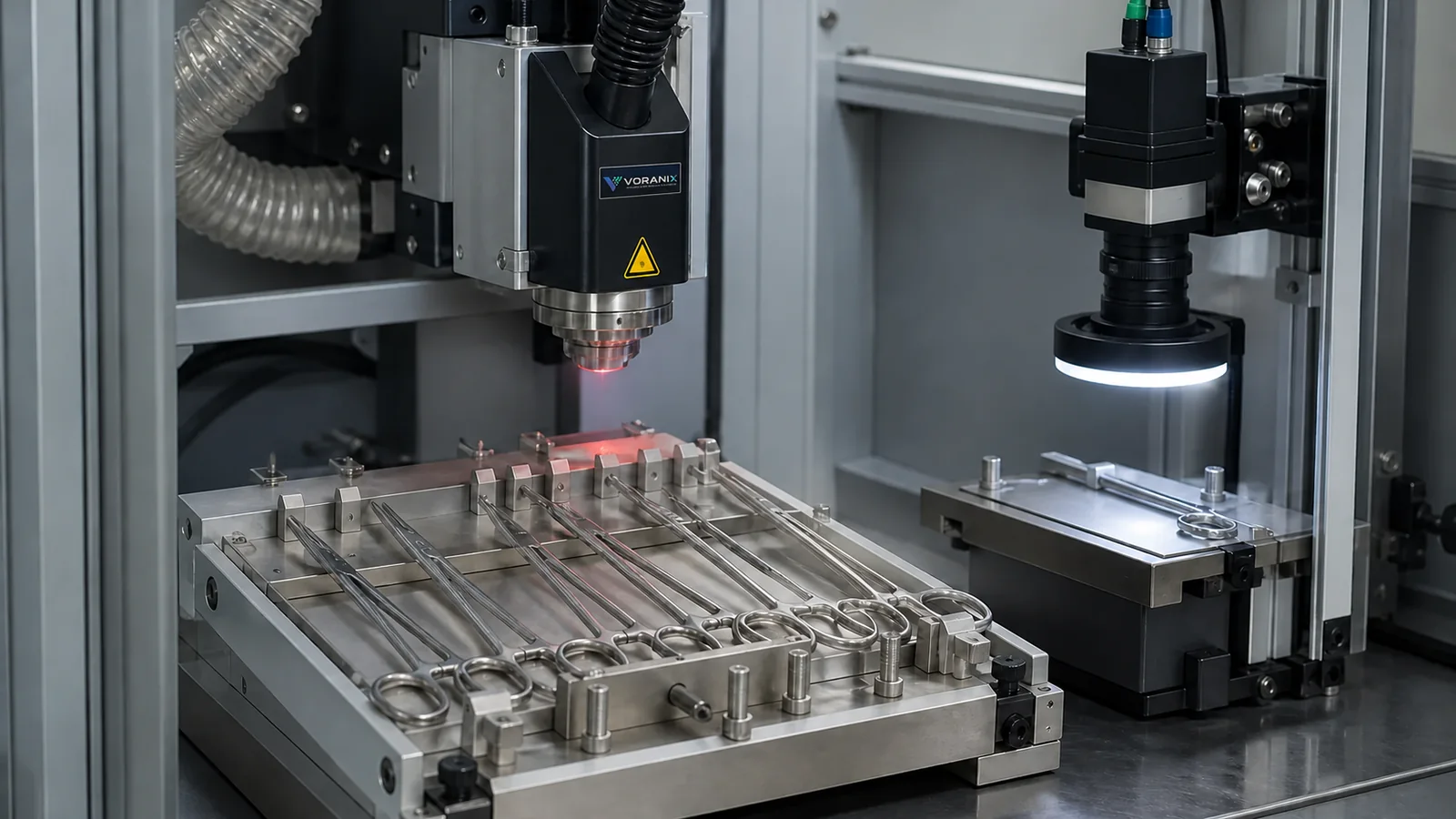
A permanent identifier on a reusable surgical instrument must remain readable while fitting a small, variable surface. This application concept combines controlled fiber-laser marking, dedicated fixturing and vision inspection.
PRODUCTION CHALLENGE
What the process must control
Instrument families can vary in curvature, finish, reflectivity and available mark area. The process must locate the marking field consistently, control the heat-affected zone, and support a code that the selected reader can evaluate. Mark appearance by itself is not proof of corrosion resistance, cleanability, durability or regulatory suitability.
PRODUCT, PACKAGING & SUBSTRATE
Inputs required before equipment selection
- Confirm the exact stainless-steel grade, surface finish, passivation state and instrument geometry.
- Define the DataMatrix content, quiet zone, human-readable characters and mark location for each instrument family.
- Record any cleaning, sterilisation, chemical exposure, abrasion and corrosion tests required by the manufacturer.
- Specify the applicable UDI data, code-quality method and acceptance owner; VORANIX does not assign regulatory status.
ACCEPTANCE CONDITIONS
Define success before trials
- Repeatable code position and orientation within the approved drawing tolerance
- Readable symbol and text after the customer's defined lifecycle tests
- No unacceptable surface damage, distortion or functional impact
- Inspection records, alarms and disposition rules agreed before production
A / B / C SOLUTION PATH
Choose the required control level
The recommended level is provisional. A VORANIX engineer must review samples, code data, line conditions, inspection criteria and system boundaries before quotation.
A. Standalone enclosed marking
Fiber laser, controller, laser-safe enclosure, interlocks, extraction and a dedicated nest for one instrument family.
Discuss this option → Recommended provisional levelB. Mark and verify
Add controlled part presentation, recipe selection, industrial lighting, vision inspection and pass/fail handling.
Discuss this option →C. Traceability-ready cell
Add authorised data input, job records, user permissions and scoped interfaces to UDI, MES or quality systems.
Discuss this option →PROVISIONAL CONFIGURATION
Recommended engineering concept
For the stated risk profile, begin with a mark-or-print and verify concept, then add traceability functions only where the data owner and recovery rules are defined.
- Enclosed fiber-laser marking station with validated focal distance and extraction
- Interchangeable poka-yoke fixture or controlled motion for the approved instrument range
- Vision camera, lens and lighting selected for reflective metal and the real code size
- Recipe control tying instrument family, marking layout and inspection task together
- Defined fail-safe response for missing, unreadable, duplicated or misplaced codes
INTEGRATION BOUNDARY
Responsibilities to agree at project start
VORANIX scope
- Laser, optics, controller, enclosure and machine-safety concept
- Fixture concept, triggering, vision hardware and inspection logic
- Sample trials, parameter record and factory-acceptance support
Customer / line-owner scope
- Approved UDI content, drawing, instrument samples and material declaration
- Regulatory interpretation, lifecycle protocol and final quality acceptance
- Plant utilities, upstream/downstream interfaces and production change control
VALIDATION PLAN
From sample to production acceptance
Mark representative samples across the real range of steel grades, finishes and geometries.
Review contrast, cell size, quiet zone, text and code position with the proposed reader.
Run the customer's cleaning, sterilisation, abrasion and corrosion protocol.
Complete line trials, challenge tests, alarm checks and documented acceptance criteria.
DESIGN TARGETS — NOT CLAIMED RESULTS
What the validated system should be designed to achieve
- Permanent, legible identification on approved instrument families
- Controlled recipe and fixture selection
- Objective code and presence inspection
- Traceable disposition of failed parts when required
RELATED EQUIPMENT
Build the application around the process
FAQ
Engineering questions
Can one fixture handle every surgical instrument?
Usually not without compromise. Instrument geometry and mark location determine whether interchangeable nests, adjustable tooling or controlled motion is the safer approach.
Does a readable DataMatrix prove UDI compliance?
No. Readability is one engineering requirement. The device manufacturer remains responsible for UDI content, regulatory interpretation, validation and release.
Can vision verify the human-readable text as well as the code?
Potentially. OCR or OCV can be added when the text size, surface contrast, lighting, fonts and acceptance rules are defined on real samples.
ENGINEERING REVIEW
Turn this application concept into a line-specific proposal
Send product samples, substrate details, code content, line speed, environment, inspection criteria and data interfaces. VORANIX will prepare two or three provisional solution paths.