A. Standalone CIJ Coding
For standard date, lot and text coding on an existing conveyor.
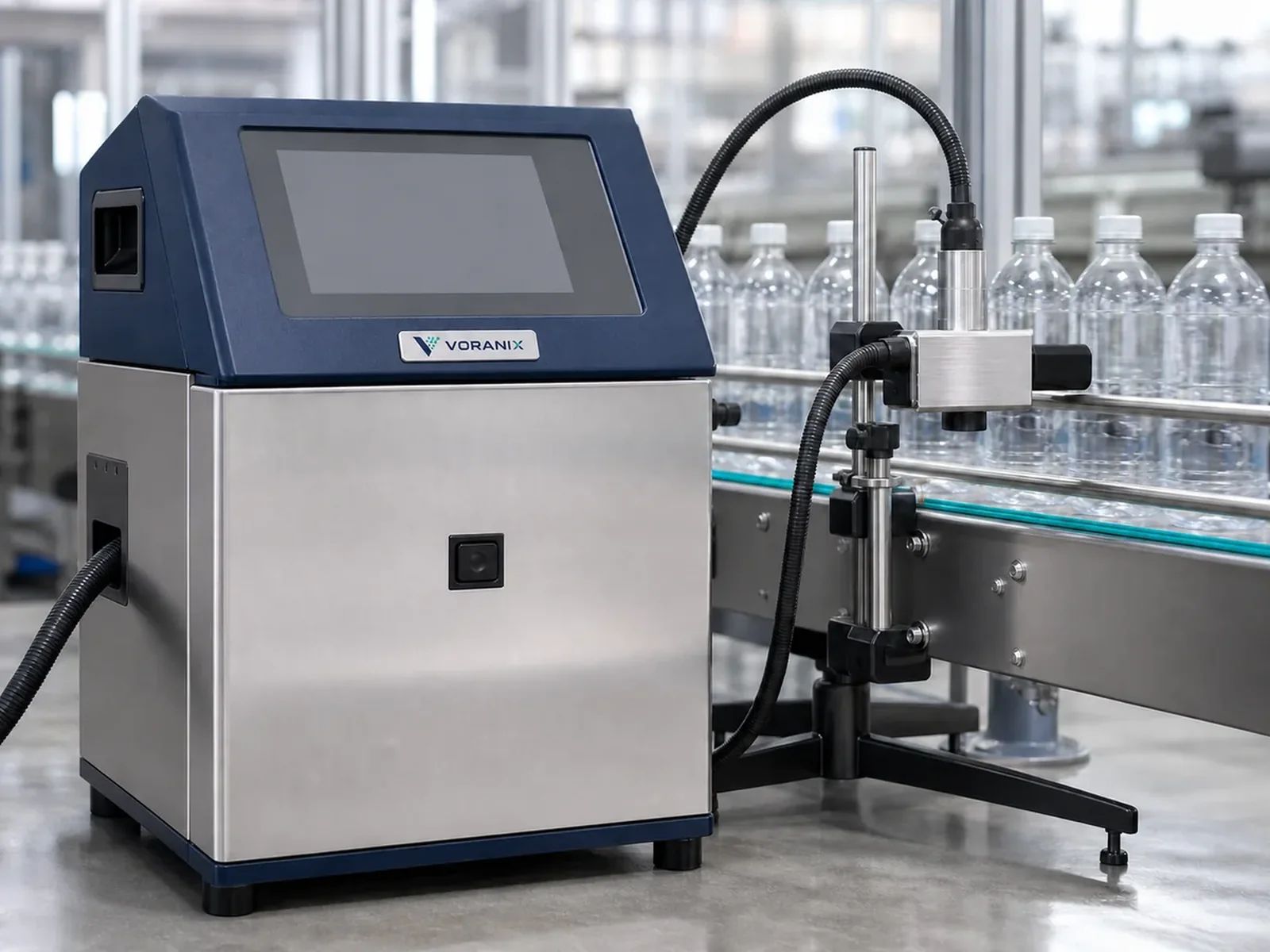
- CIJ printer and printhead mount
- Product sensor and encoder if required
- Local message creation and selection

Non-contact production-line coding
Plan a VORANIX CIJ coding solution around the substrate, ink adhesion, code content, line speed, environment and maintenance workflow.
Application fit
A CIJ printer is evaluated when products move continuously and the code must be applied without contact. Selection depends on adhesion, drying time, throw distance, code height, line speed, washdown or dust exposure and the operator maintenance routine.
Three scalable system levels
These are provisional architectures. Final components and boundaries depend on engineering discovery and verified technical data.
For standard date, lot and text coding on an existing conveyor.
For checking code presence, position or selected content after printing.
For controlled messages, variable data and production records.
Technical parameters
| Field | Current status | Required source |
|---|---|---|
| Model | Not supplied | Verified datasheet, model label or engineering record required |
| Printing Technology | Not supplied | Verified datasheet, model label or engineering record required |
| Print Lines | Not supplied | Verified datasheet, model label or engineering record required |
| Character Height | Not supplied | Verified datasheet, model label or engineering record required |
| Maximum Speed and Test Conditions | Not supplied | Verified datasheet, model label or engineering record required |
| Nozzle or Resolution | Not supplied | Verified datasheet, model label or engineering record required |
| Throw Distance | Not supplied | Verified datasheet, model label or engineering record required |
| Ink and Color Options | Not supplied | Verified datasheet, model label or engineering record required |
| Display and User Interface | Not supplied | Verified datasheet, model label or engineering record required |
| Communication | Not supplied | Verified datasheet, model label or engineering record required |
| IP Rating | Not supplied | Verified datasheet, model label or engineering record required |
| Dimensions and Weight | Not supplied | Verified datasheet, model label or engineering record required |
| Power and Air Requirements | Not supplied | Verified datasheet, model label or engineering record required |
| Operating Environment | Not supplied | Verified datasheet, model label or engineering record required |
| Applicable Substrates | Not supplied | Verified datasheet, model label or engineering record required |
| Optional Functions | Not supplied | Verified datasheet, model label or engineering record required |
Material screening
Production tasks
Available visual evidence
Images are presented as application-screening evidence only. They do not establish production speed, durability, verification grade or compliance.
Selection guide
State material, color, surface treatment, moisture, oil and temperature at printing.
Provide lines, characters, height, language, barcode or 2D requirements and change frequency.
Provide speed range, product spacing, print direction, throw distance and encoder conditions.
Describe dust, washdown, humidity, solvent restrictions, ventilation and maintenance access.
Engineering integration
The final CIJ configuration requires a verified printer datasheet, approved ink and safety data, mounting drawing, sensor and encoder logic, line-speed test, ventilation review, cleaning plan, communication protocol and acceptance criteria.
No verified customer, site, model, before/after result or publication permission was found. Add a case study only after those records are supplied.
Review case-study requirementsFrequently asked questions
CIJ is commonly evaluated for continuous non-contact coding on varied moving products. TIJ is often considered for high-resolution coding at controlled throw distance. The real substrate and line decide.
No speed can be published until the exact model, code height, content, print pitch and test conditions are supplied.
Potentially, with the correct ink and surface conditions. Adhesion and drying must be tested on production samples.
Yes, provisionally. The inspection task may range from presence and position to OCR or code reading, and each requires different optics and logic.
Request a provisional system concept
VORANIX can compare standalone, print-and-verify and traceability options after the key application variables and samples are reviewed.